Emergency & Incident Management

NexMed. When coordination breaks down, that's the real emergency.

NexMed gives hospitals, EMS agencies, and public health partners one connected platform for incident command, real-time patient and resource tracking, and multi-channel alerting, so crisis response runs on live data, not phone trees and paper rosters.

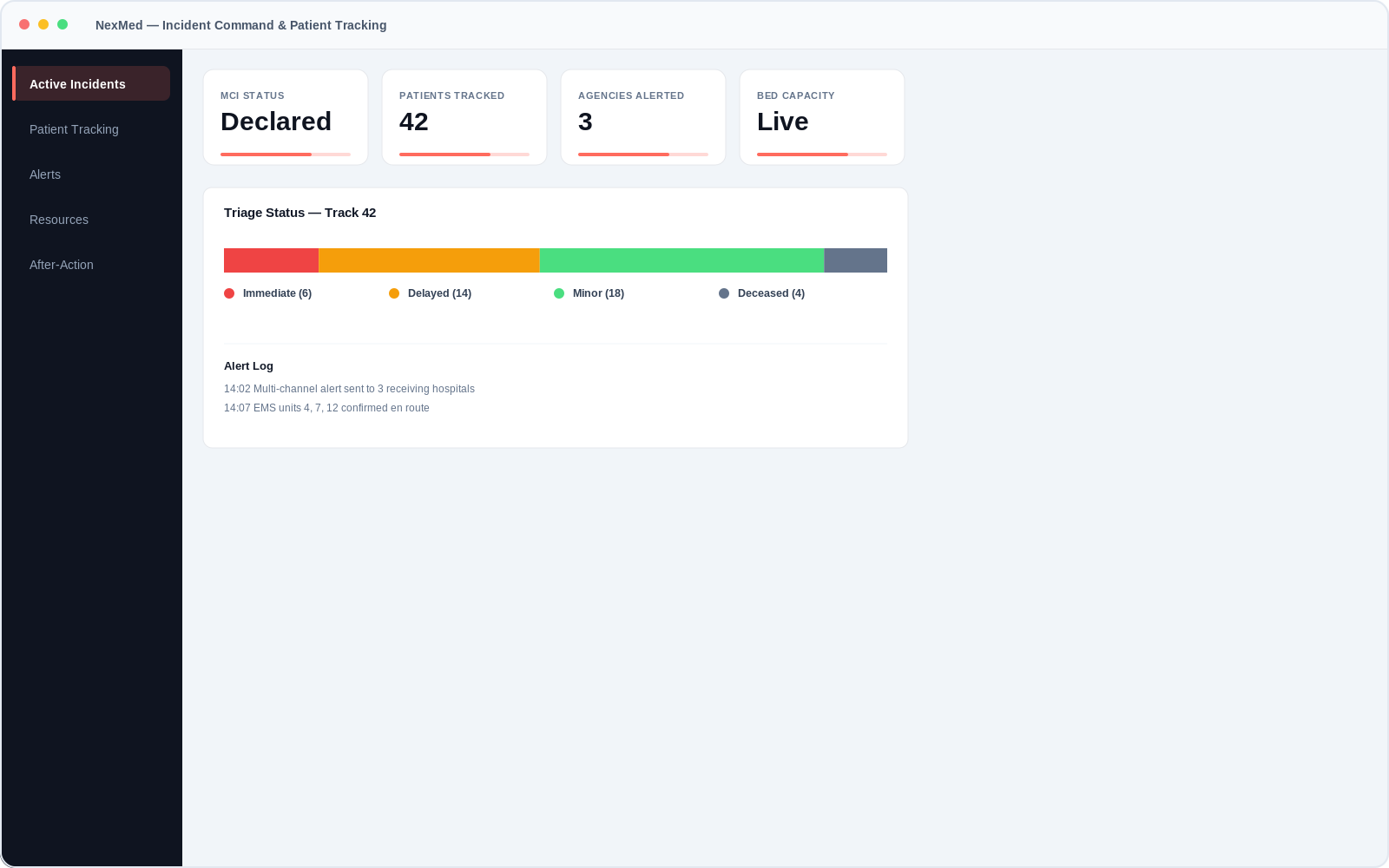
NexMed incident command and patient tracking dashboard
MCI Declared · Track 42
Alert Sent: 3 Agencies
Minutes
To stand up a full incident command structure with NexMed's prebuilt ICS templates
One
Shared operating picture across hospitals, EMS, and public health partners
Automatic
After-action documentation, generated from the incident log, not reconstructed afterward
The Problem NexMed Solves

Disconnected systems. Manual updates. Delayed alerts. The coordination gap is the real crisis.

When a mass-casualty incident, hospital evacuation, or public health emergency hits, most organizations are still coordinating through phone trees, radio traffic, and paper rosters, while the systems that hold patient, resource, and staffing data sit disconnected from each other. NexMed closes that gap with one connected platform built for the moment coordination matters most.

Incident command activation.

Pre-built ICS role templates and structured task assignments stand up a command structure in minutes, not hours spent improvising an org chart during the opening minutes of an incident.

Real-time patient tracking.

Every patient movement (triage, transfer, evacuation) is tracked from barcode or ID scan through to final disposition, so no one is lost between the scene and the shelter.

Live capacity & resource visibility.

Bed status, ED load, and resource availability surface across every connected facility in real time, replacing the daily status call with a shared operating picture.

Multi-channel alerting.

Targeted notifications reach the right people by role, region, or agency (over voice, text, email, and inbox), with delivery and response tracked automatically.

Volunteer & responder deployment.

Credentialing, background verification, and mission assignment for surge staffing, so the right qualified people are activated fast, not weeks late.

After-action reporting.

Every action, alert, and task is logged automatically as the incident unfolds, turning the debrief into a formality instead of a reconstruction project.

Key Capabilities

Built for the moment coordination matters most.

Command

Incident Command (ICS)

Prebuilt HICS templates, role assignments, and task logs stand up a structured command center the moment an incident is declared.

Tracking

Patient & Population Tracking

Mobile capture of triage tags, barcodes, and photos follows every patient through transfers, mass-casualty events, and evacuations.

Visibility

Real-Time Capacity Dashboards

Live bed counts, ED load, and diversion status across every connected facility, filterable by region, facility type, or specialty.

Alerting

Multi-Channel Notification

Precision alerts by role, region, or organization, delivered by voice, text, email, and inbox, with full delivery and response tracking.

Workforce

Volunteer & Responder Management

Pre-event registration, credential verification, and mission deployment for a ready-to-activate surge workforce.

Reunification

Family Reunification Support

Shared patient location data across sites and shelters speeds reunification during large-scale evacuations and mass-casualty events.

Planning

Hazard Vulnerability Analysis

Built-in HVA tools identify and prioritize the risks most likely to affect a given facility or region, informing readiness planning before an incident occurs.

Compliance

Standards-Based Documentation

Incident and patient tracking data captured to CMS, TJC, NEMSIS, and HHS standards, audit-ready without added paperwork.

The Incident Response Workflow

From activation to after-action. One shared operating picture.

When an incident is declared (a mass-casualty event, a hospital evacuation, a public health outbreak), NexMed activates a structured incident command center in minutes. Prebuilt ICS role templates assign responsibilities, and the command team works from a single shared operating picture instead of a whiteboard and a phone tree.

As patients move through the event, field and facility teams capture triage tags, barcodes, and photos on mobile devices, building a live record of where every patient is and where they're headed next. That same view surfaces real-time bed status and resource availability across every connected facility, so transfers route to capacity that actually exists.

Multi-channel alerts keep every stakeholder (hospital staff, EMS, public health partners, activated volunteers) informed as conditions change, with delivery and response tracked automatically. When the incident closes, the full timeline of tasks, alerts, and decisions is already logged, ready for the after-action report.
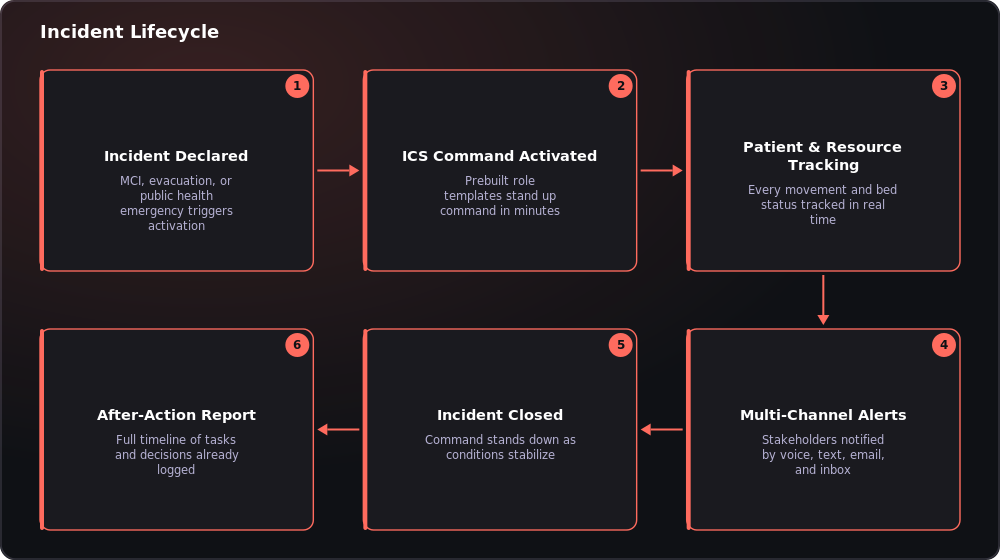
Incident Lifecycle, Activation to After-Action Diagram
Who It's For

Every partner who has to move together when an incident hits.

Hospitals

Hospital Incident Command Teams

Structured ICS activation, real-time capacity visibility, and patient tracking for mass-casualty events, evacuations, and internal emergencies.

Public Health

Public Health Agencies

Multi-channel alerting and resource coordination across facilities and jurisdictions during outbreaks, mass vaccination clinics, and regional emergencies.

Field Response

EMS & Emergency Preparedness Teams

Shared situational awareness with receiving facilities during MCIs and evacuations, patient tracking that starts at the scene and continues to final disposition.

Workforce

Volunteer & MRC Organizations

Credentialing, verification, and mission deployment tools that turn a volunteer roster into an activated, accountable workforce during surge events.

Platform Integration

NexMed is the incident-response layer of the Brilliancy Health ecosystem.

Emergency coordination doesn't happen in isolation. NexMed is connected across the Brilliancy Health platform (and hands off cleanly to routine operations), so nothing is re-entered and nothing is lost between "normal" and "incident."

AXIA Medical

Patient Record Continuity

NexMed reads and writes to the AXIA Medical patient record, so incident-tracked patients carry a continuous clinical history into and out of declared events.

NexEMS + NexPCR

Field-to-Command Visibility

Field dispatch and PCR data from NexEMS and NexPCR feed NexMed's incident command view, giving command staff the same real-time picture as crews in the field.

NexCommand

Routine Ops to Incident Handoff

NexCommand runs day-to-day capacity and staffing. The moment an incident is declared, NexMed takes over incident-scope command, tracking, and multi-agency coordination, with a clean handoff back at closeout.

Luminous

External Agency Connectivity

Luminous connects NexMed to external EHRs, CAD/GIS systems, and partner agencies over HL7/FHIR, without custom middleware or brittle point-to-point integrations.

Frequently Asked Questions

What teams ask before they deploy NexMed.

Turn emergency readiness into real-time coordination.

Talk to the Brilliancy Health team about deploying NexMed, and see how one connected platform for incident command, patient tracking, and alerting keeps every partner working from the same picture when it matters most.

Request a Demo